The Recovery Window Most Runners Underestimate
The finish line isn't the end of your marathon journey — it's the start of the next one. While most training plans dedicate months to building up to race day, far fewer give serious thought to what happens after you cross the line. Yet according to Les Mills trainer Holly Mason, "two to four weeks to fully recover from a marathon" is the realistic window for the average runner. Cut that short, and you're not training again — you're accumulating damage. Honour it, and you set yourself up for stronger seasons ahead.
WHAT 26.2 MILES ACTUALLY DOES TO YOUR BODY
Marathon running places sustained stress on nearly every system in the body. Muscle fibres are broken down and need time to rebuild. Glycogen stores are depleted. Joints, tendons and ligaments absorb tens of thousands of foot strikes. Hormones, hunger and sleep patterns all shift in the days that follow. Understanding the toll is the first step to recovering from it properly — because the body needs more than a good night's sleep to come back from 26.2 miles.
UNVEILING THE BENEFITS OF STRATEGIC RECOVERY
Treating recovery as a discipline — not an afterthought — pays off in measurable ways:
- Injury Prevention: Allowing muscles, tendons and ligaments time to repair dramatically reduces the risk of overuse injuries that often surface in the weeks after a marathon.
- Performance Preservation: Proper recovery protects the gains you spent months building. Skipping it accelerates fitness loss and undermines your next training block before it even begins.
- Hormonal Rebalancing: Long-distance running elevates cortisol and disrupts hormonal rhythms. Rest gives your endocrine system time to reset.
- Mental Restoration: The post-marathon comedown is real. Built-in recovery time protects motivation, mood and the long-term love of running.
- Sleep Quality: Deep, restorative sleep is when the bulk of muscular repair happens — making rest itself the most powerful recovery tool you have.
THE FIRST 72 HOURS: WHAT TO DO WHEN YOU CROSS THE LINE
The instinct after a marathon is to collapse. Resist it — for a few minutes, at least. Gentle movement immediately post-race helps flush lactic acid and prevents muscles from seizing up. From there, the priorities shift quickly:
- Keep Moving (Gently): A slow walk back to your kit bag, light stretching at the meeting point — small movements that signal your body to begin repair, not shut down.
- Refuel Within the Hour: Aim for easy-to-digest carbs paired with protein in the first 30–60 minutes. A banana with nut butter, a recovery shake, or a proper meal if you can stomach it.
- Rehydrate Properly: Water plus electrolytes — not just water. You've lost more salts than you realise.
- Elevate and Reduce Impact: Get your feet up. Switch into supportive recovery footwear. Every step you take in regular shoes is one your tired joints have to absorb.
FUELLING YOUR RECOVERY
Recovery eating is about consistently combining protein and carbohydrates to support muscle repair and replenish energy stores. In the days after a marathon, balanced meals beat any single "superfood." Focus on whole foods, lean proteins, complex carbs, and plenty of fluids. Listen to your hunger cues — they'll be louder than usual, and that's your body asking for what it needs.
FOUR STRETCHES EVERY RUNNER SHOULD DO POST-RACE
Static stretching is most effective when muscles are warm and pliable — which is exactly the state they're in immediately after a long run. Focus on the areas that took the heaviest load:
- Hip Flexor Stretch: Targets the hips, quads and glutes — the muscles that powered every stride and tighten the most afterwards.
- IT Band Stretch: Releases tension along the outer hip and thigh, where post-marathon tightness most commonly settles.
- Side-to-Side Lunges: A dynamic movement that restores hip mobility and inner-thigh flexibility while supporting stability.
- Calf Stretch: Your calves carried you through the wall. Stretching them post-race reduces soreness and protects ankle mobility for the days ahead.
REINTRODUCING STRENGTH TRAINING SAFELY
Returning to the weights room too soon is one of the most common post-marathon mistakes. A sensible week-by-week approach:
- Week One: Avoid strength training entirely. If your muscles are still sore, they're not ready for resistance work.
- Week Two: Reintroduce light bodyweight exercises or one to two low-load sessions. Movement, not intensity.
- Weeks Three to Four: If your body has fully recovered — no lingering soreness, full energy returning — your normal strength routine can resume.
LEVERAGING OOFOS RECOVERY FOOTWEAR FOR ENHANCED RECOVERY
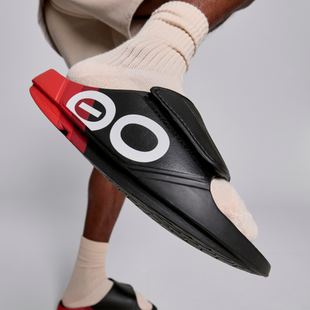
Reducing impact between runs is one of the most underrated recovery levers — and it's where OOFOS earns its place in your post-marathon kit. "Recovery is just as important as the miles you run," says Giles Cundell, Head of International at OOFOS. "Stretching, good sleep and hydration all help, but so does reducing impact between runs."
Featuring innovative OOfoam™ technology, OOFOS footwear absorbs 37% more impact than traditional foam footwear, alleviating stress on your feet and joints with every step. Your feet are often the most fatigued part of your body after a marathon, yet they keep working every time you stand up to make a coffee or walk to the door. By wearing OOFOS recovery footwear during your downtime, you can reduce that ongoing impact, support muscular repair and protect the recovery work the rest of your routine is doing.
The newly launched OOahh PLUS evolves the OOahh family with more OOfoam™ underfoot, a wider strap and a raised rim for a more secure, contoured fit — designed for the days after the days that matter most. Recently spotlighted by Living360 in their expert marathon recovery edit, the OOahh family was singled out as a standout for protecting tired joints between runs.
CONCLUSION: A HOLISTIC APPROACH TO POST-MARATHON RECOVERY
The marathon doesn't end when you cross the line. The way you spend the days and weeks that follow shapes how your body adapts, how quickly you return to running, and how strong you'll feel when the next training block begins. By combining intentional rest, smart fuelling, targeted stretching and the right recovery footwear, you give your body the conditions it needs to rebuild — not just back to where it was, but stronger. Recovery isn't a pause from training. It's the part that makes the next start line possible.